
Two Payment Rails, Two Very Different Trade-Offs
If your business runs bulk payroll or high-volume supplier payments in the UK, the money almost certainly moves through one of two systems: BACS or Faster Payments. Both transfer funds between UK bank accounts, but they were built for different purposes, and choosing the wrong one for your payment profile can create avoidable cost, delay, and operational risk.
This guide explains how each system works, where the practical differences lie for payroll and finance teams, and why a growing number of high-volume businesses are looking beyond the BACS-or-Faster-Payments question altogether.
How BACS Works for Bulk Payments
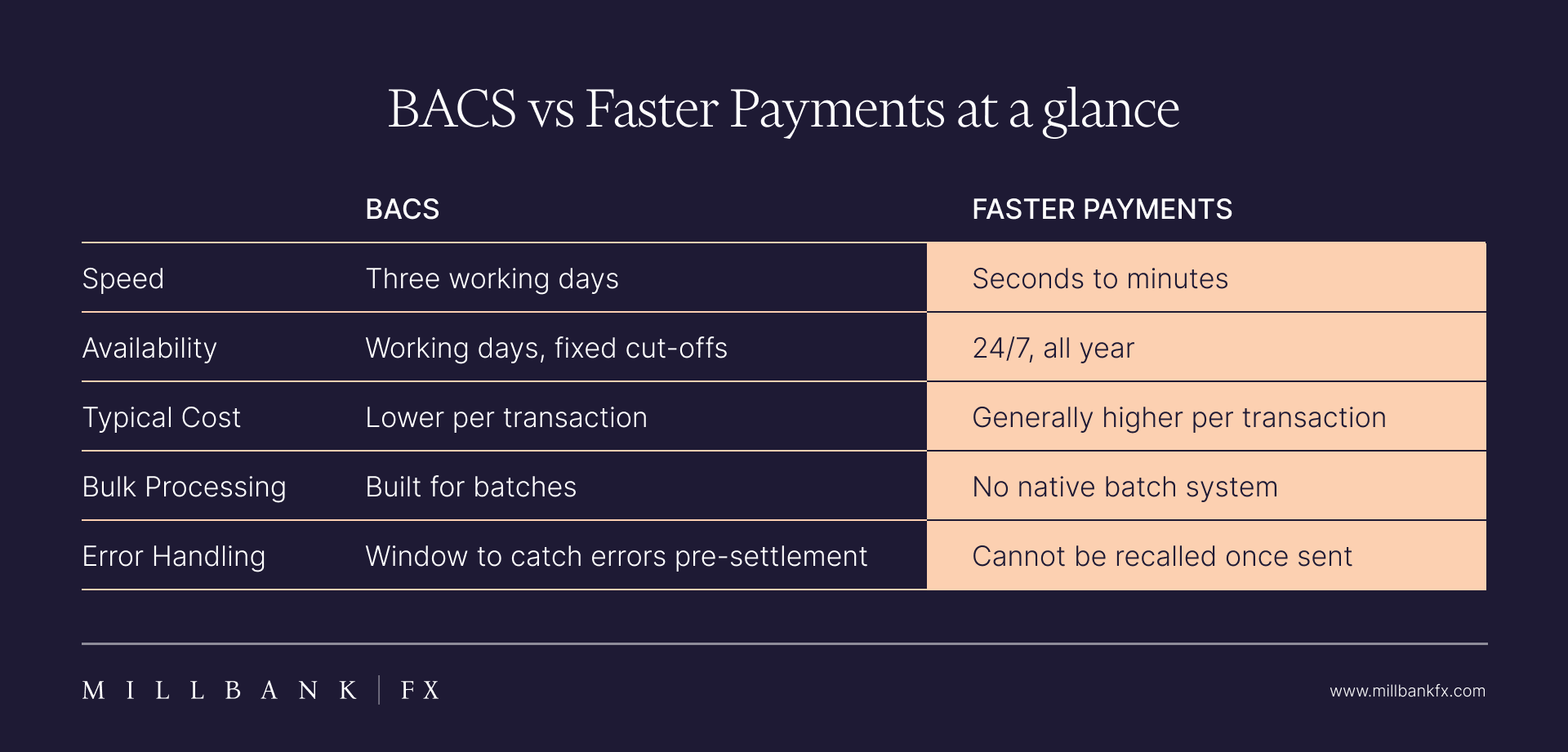
BACS (Bankers' Automated Clearing Services) has been the backbone of UK payroll for decades. It processes payments in batches on a fixed three-working-day cycle: the file is submitted on day one, processed on day two, and funds arrive on day three.
Its main advantage is cost. BACS transactions are typically among the lowest-cost ways to move money in the UK, which makes the system attractive for large, predictable pay runs. Its main constraints are structural. BACS only runs on banking working days, so weekends and bank holidays extend the cycle. Files must be submitted before strict cut-off times, and a file submitted on a Friday will generally not land until the following Wednesday.
There are also access and overhead considerations that are easy to underestimate. Submitting BACS payments directly usually requires a Service User Number (SUN) and a sponsoring bank, so many businesses route their files through a BACS-approved bureau or payroll software instead, each of which adds its own fees. Rejected files can also carry additional charges, and because validation happens within a rigid template, formatting issues are a recurring cause of failed submissions.
How Faster Payments Works for Payroll
Faster Payments is the UK's real-time payment network. Individual payments typically settle within seconds or minutes, and the service runs 24 hours a day, every day of the year, including weekends and bank holidays.
For payroll teams, this speed is valuable for off-cycle payments: emergency salary corrections, leaver payments, advances, and last-minute additions to a pay run. There is no multi-day clearing cycle to plan around and no fixed submission window.
The trade-offs sit elsewhere. Per-transaction costs are generally higher than BACS, particularly through corporate banking channels, which matters when you are sending hundreds or thousands of payments in a run. Faster Payments also has no native batch infrastructure of its own, so bulk processing depends entirely on the tools your bank or provider layers on top. And because payments settle in near real time, they cannot be recalled once sent, so an error in a beneficiary detail is significantly harder to unwind than a BACS error caught during the clearing window.
Comparing the Two for High-Volume Pay Runs
For a scheduled monthly payroll with a stable recipient list, BACS remains a sensible default: the three-day cycle is manageable when pay dates are known well in advance, and the per-payment cost is low.
The picture changes for businesses with weekly pay cycles, fluctuating headcounts, or time-sensitive obligations. Recruitment agencies, umbrella companies, and payroll bureaus processing weekly runs have far less margin for error within a three-day clearing cycle. A single failed file submission or missed cut-off can push payments past pay day, and the operational consequences of that, worker escalations, client complaints, and emergency re-runs, usually cost far more than any per-transaction saving.
Many businesses end up running a hybrid: BACS for the predictable bulk, Faster Payments for exceptions. This works, but it also means maintaining two workflows, two sets of cut-offs, and two reconciliation processes, and the burden of preparing, validating, and troubleshooting files still sits with your team in both cases.
The Third Option: A Managed Mass Payment Service
The BACS-versus-Faster-Payments comparison assumes your team handles the payment execution itself. A managed mass payment service changes that assumption.
In a managed model, you send your payment file, in whatever format your payroll or accounting system produces, to a specialist provider. The provider's team cleans and validates the file, flags any issues before money moves, and routes each payment via the fastest available rail for its destination. Domestic payments can be executed same-day where the rail supports it, and international payments within the same run are routed through the appropriate currency channels.
The practical effect is that the rail becomes the provider's problem rather than yours. Your team is no longer reformatting files to match a rigid template, tracking multiple cut-off times, or discovering failed payments after pay day has passed. For a detailed look at what this workflow involves, see our guide to mass, bulk, and batch payments.
How Millbank FX Handles Bulk Payroll Payments
Millbank FX provides a fully managed mass payment service built for payroll companies, umbrella companies, recruitment firms, and high-volume employers. You send your file; our team validates it, resolves issues before payments are released, and processes the run using the fastest available route for each payment, with most payments processed same-day.
We are authorised by the FCA, client funds are safeguarded, and we support payments in over 80 currencies to 120+ countries. Across all mass payment processing we have maintained a 0.05% kickback rate, and you have direct access to the team handling your run throughout the cycle.
If you are weighing up BACS, Faster Payments, or a change of provider for your bulk payroll, book a 15-minute demo and we will show you exactly how a managed run works for your specific volumes and pay cycle.