Most international business payments in a major currency arrive within a business day, and a good many within hours. Euro payments inside SEPA settle the same or next day, or in seconds where instant rails are supported. A payment to a less common currency, routed through two or three correspondent banks, can take two to five business days. So far, so predictable. The problem is the gap between "usually a day" and "it has been a week and nobody will tell us why", and that gap is almost always one of three things: a cut-off was missed, the beneficiary details did not validate, or a bank somewhere in the chain has stopped the payment for a compliance check it is not permitted to discuss with you.
What "normal" looks like, by route
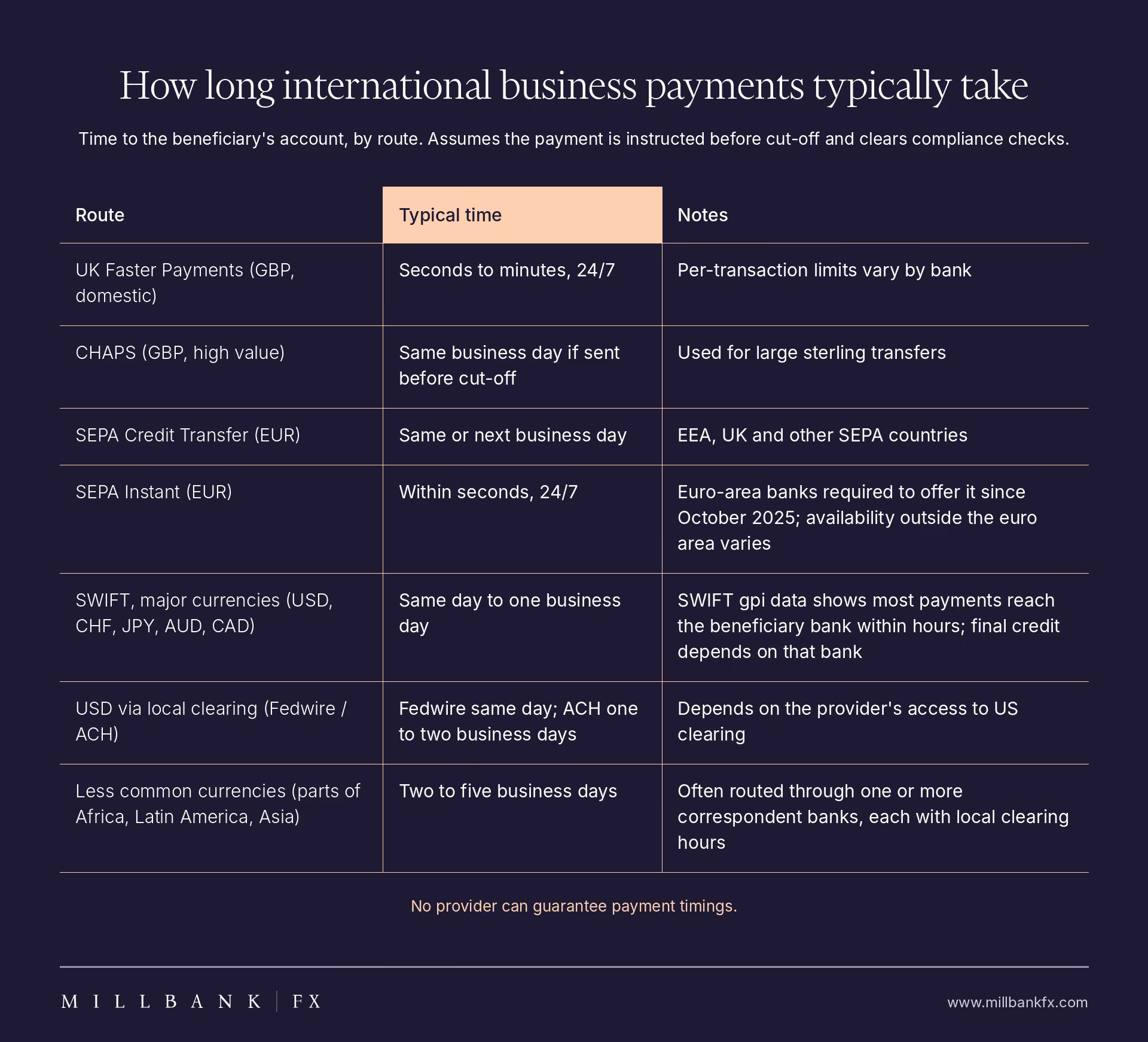
UK Faster Payments in sterling land in seconds to minutes, around the clock, subject to per-transaction limits that vary by bank. CHAPS, for large sterling transfers, settles the same business day if sent before cut-off. A SEPA credit transfer in euros settles the same or next business day across the EEA, the UK and the other SEPA countries, and SEPA Instant settles within seconds, 24/7; euro-area banks have been required to offer instant euro payments since October 2025, though availability outside the euro area still varies. SWIFT payments in the major currencies, dollars, Swiss francs, yen, Australian and Canadian dollars, typically take same day to one business day, and SWIFT's own gpi data shows most reaching the beneficiary bank within hours. Dollars sent through US local clearing settle the same day on Fedwire and in one to two days on ACH, depending on your provider's access. Less common currencies in parts of Africa, Latin America and Asia are the two-to-five-day cases, because they tend to pass through one or more correspondent banks, each with its own hours.
Two definitions do a lot of work here. The value date is when the sending bank releases the funds. The credit date is when the beneficiary can actually use them. For major currencies they are often the same; elsewhere they can differ by a day or more. And the cut-off time is the latest point in the day at which a bank or provider will process a payment in a given currency for same-day value. A dollar payment instructed at five o'clock UK time will move tomorrow, not today. That one fact accounts for a startling share of "it hasn't arrived" calls.
Why a payment that has left has not arrived
In rough order of how often we see it. The cut-off was missed, so the payment moves next business day. Time zones and local hours: a payment sent on a Friday afternoon to a bank in a country whose weekend is Friday and Saturday gets looked at on their Sunday. Correspondent banks: for currencies the sending bank cannot deliver directly, the payment hops through intermediaries, and every hop can cost a day. Beneficiary details that fail validation: a wrong IBAN check digit, a BIC that does not belong to the account's bank, a name that does not match the account holder, or, increasingly, an address typed into one line rather than structured fields. Since SWIFT's move to ISO 20022 in November 2025, banks have tightened validation of structured data, and payments that would once have slipped through on a free-text address are now being bounced or held. Conversion at the receiving end: if the money arrives in a currency the beneficiary's account does not hold, their bank converts it, adding a day and a charge. And last, the one everybody dreads: a compliance hold.
Why payments get held, and why nobody will say why
This is the delay that generates the most anger, so it deserves a proper explanation rather than a shrug.
Every regulated firm that moves money has to screen payments against sanctions lists and has to understand the purpose of the transactions it processes. Screening is automated and works on names. A beneficiary whose name resembles one on a list, or a payment reference containing a flagged word or country, gets stopped for a human analyst to look at. Separately, a payment that does not fit the pattern the bank expects from your business, a new beneficiary, a new country, an unusual amount, a sector the bank classes as higher risk, may be routed for review before release.
While a payment is under review, the firm holding it is often legally restricted in what it can tell you. UK anti-money-laundering law makes it a criminal offence to tip off a customer that a report has been made or an investigation is under way. So the person on the phone may be unable to tell you why the payment is held, or even confirm that it is being reviewed, until it is released or returned. This is not obstruction. It is the law working as designed, and it binds banks and specialist providers alike. Being furious with the person who cannot answer does not shorten the hold.
What does shorten it is answering the request for information. The firm can usually ask you for an invoice, a contract, a description of the goods, the source of the funds. Most holds run from a few hours to a few business days. The ones that drag on for a week are, in our experience, almost always waiting on a reply from the client.
Preventing the delay in the first place
Onboard properly. A provider that understands your business, your suppliers and your trading pattern at the start routes far fewer of your payments for review later. Handing over bank statements and incorporation documents feels like friction on day one. It is what removes friction on payment day. Our guide to KYC for importers explains what gets asked for and why.
Validate beneficiary details before the first payment, not after the first failure: run the IBAN through a check-digit validator, confirm the BIC belongs to the right bank, match the account name exactly, and store the address in structured fields. Attach the invoice and a clear purpose to the first payment to any new beneficiary; it pre-empts the most common request for information. Know the cut-off time for every currency you pay and build your payment run around it. Use local clearing where it exists, because a dollar payment through US clearing or a euro payment through SEPA skips the correspondent chain entirely; ask your provider which currencies they can deliver locally. Decide deliberately who pays the bank charges: OUR means the beneficiary receives the full amount, SHA splits them, and a supplier who gets paid short will often hold the goods. Get the UETR, the 36-character tracking reference every SWIFT payment carries, at the moment of sending, and give it to your beneficiary so their bank can trace it; our article on the MT103 and what replaced it explains how tracking works now. And have a named contact. A dealer who can trace a payment and tell you what is needed to release it shortens a hold more than anything else on this page.
When a payment is late anyway
Confirm the instruction actually went: ask for the payment confirmation and the UETR. Check the value date against the cut-off; if it was instructed after cut-off, the value date is the next business day and nothing is wrong. Ask your provider to trace it. A gpi trace shows whether it is in progress, held, rejected or completed, and at which bank. Have the beneficiary check with their bank using the UETR, because the payment may simply be sitting in their queue for conversion or review. Answer any request for information the same day. And if the payment is returned, read the reason code before you resend, because resending a payment that bounced for a sanctions match produces exactly the same result, one day later.
How Millbank FX handles it
Millbank FX processes a client's supplier payment once cleared funds have arrived from the client, subject to the currency's cut-off and any compliance checks. Every outgoing payment is dual-checked before release, beneficiary details are validated, and clients deal with a named dealer who can trace a payment and say what, if anything, is needed to free it. Clients who prefer to control the final step can use a named multi-currency account: we deliver the converted currency to the client's own account and the client pays the supplier directly. For high-volume pay runs, our mass payments service validates files before anything is submitted. More on our international payments page.
This article is general information, not advice. Payment timings depend on the currency, the route, cut-off times, the banks involved and any regulatory checks, and no provider can guarantee them.