Why Provider Selection Matters More at Volume
For a business sending a handful of payments a month, the choice of payment provider is a minor decision. For a business sending hundreds or thousands of payments per run, weekly payroll, contractor disbursements, supplier settlements, it is one of the most operationally significant decisions the finance function makes. A weak provider does not just cost more per transaction; it consumes team time in file preparation, creates failed-payment escalations, and puts pay dates at risk.
This guide sets out the questions that separate providers built for high-volume processing from those that merely offer a bulk upload button. It applies whether you are moving away from a bank, replacing a self-service platform, or reviewing an incumbent provider.
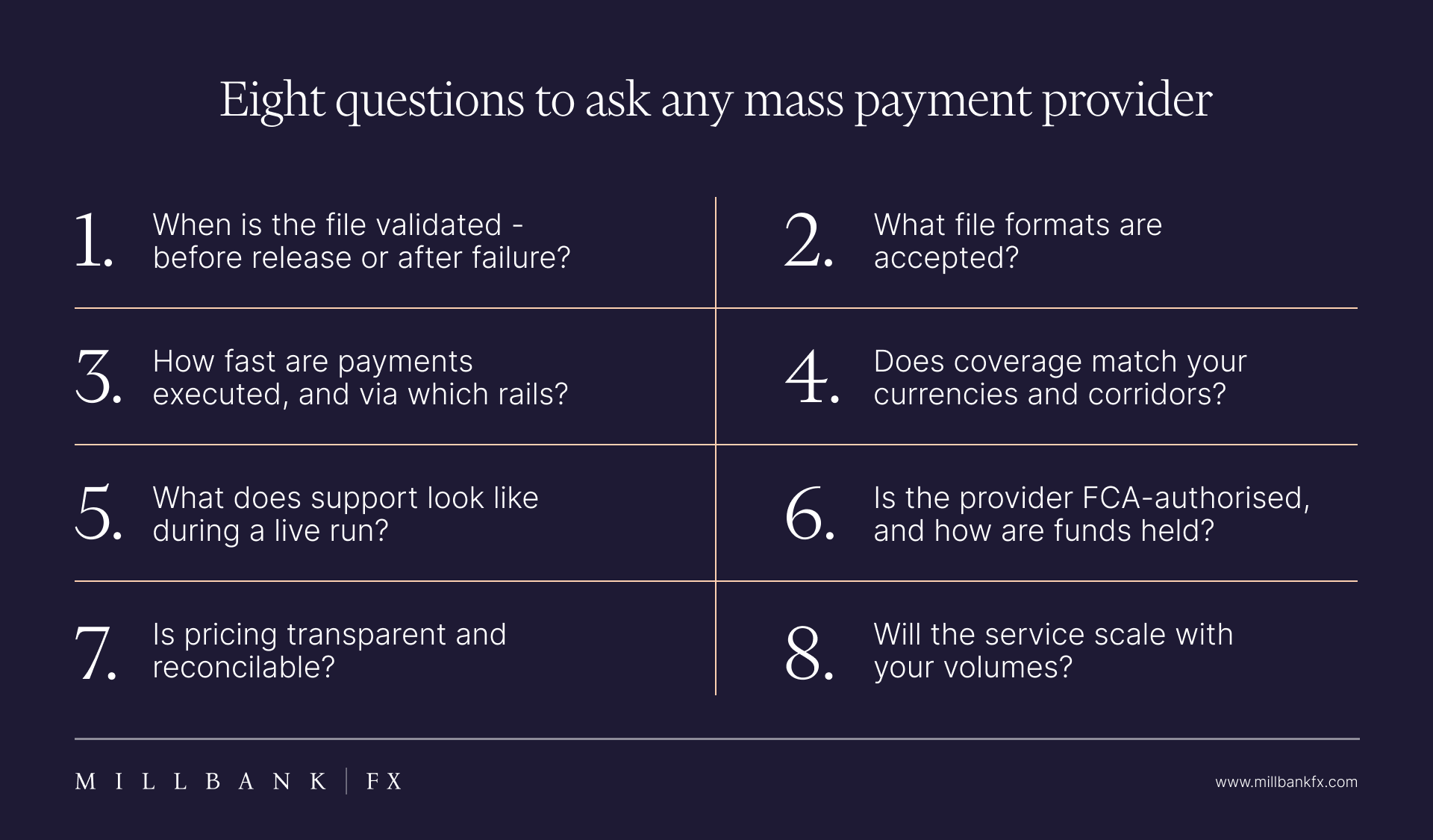
1. How Is the Payment File Validated, and When?
This is the most important question on the list. Ask the provider precisely when errors in your file are detected: before payments are released, or after they fail.
Many platforms accept a file, process it, and report failures afterwards. That means an incorrect sort code or a closed account only becomes visible once the payment has bounced, often after your pay date. Providers built for payroll-grade reliability validate the file before release, catching formatting issues, structural errors in account details, and missing fields while they are still correctable. Ask for the provider's failure or kickback rate, and ask how it is measured.
2. What File Formats Are Accepted?
If the provider requires a fixed template, your team will reformat every export from your payroll or accounting system before every run, a recurring manual step and a recurring source of error. Providers offering a managed service accept the file your system produces and handle formatting themselves. If you run multiple clients on different payroll systems, as bureaus and umbrella companies typically do, this difference compounds with every client you add.
3. How Fast Are Payments Executed, and via Which Rails?
Ask which payment rails the provider uses for domestic payments, whether same-day execution is available, and what the cut-off times are. For international payments, ask how routing decisions are made per currency and destination, and what expected settlement times look like for the specific corridors you use. A provider that can process most payments same-day, and can tell you before the run when each payment type will land, removes a major source of pay-day uncertainty. Our comparison of BACS and Faster Payments for bulk payroll explains why rail selection matters.
4. What Currency and Country Coverage Do You Actually Need?
Map your current and likely future payment destinations, then check them specifically against the provider's coverage. Broad headline numbers matter less than whether your corridors are supported efficiently. If you pay contractors or suppliers internationally, ask whether multiple currencies can be included in a single file, and how FX pricing is presented, per transaction and before execution, so you can reconcile accurately. For international runs, our guide to cross-border mass payments covers the additional questions worth asking.
5. What Does Support Look Like When Something Goes Wrong at 4pm on a Friday?
Every provider offers support; the question is what kind. Ticketing queues and chatbots are adequate for routine queries and inadequate for a stalled pay run with workers expecting payment that day. Ask whether you get direct access to the team that actually processes your payments, whether they know your account and file structure, and what the escalation path is during a live run. This single factor is often what drives businesses to switch, as we explore in why payroll companies are switching providers.
6. Is the Provider Regulated, and How Are Client Funds Held?
Confirm the provider's regulatory status, in the UK, authorisation by the Financial Conduct Authority as a payment or e-money institution, and verify it on the FCA register. Ask how client funds are held: authorised payment institutions are required to safeguard relevant client funds, keeping them in accounts separate from the firm's own operating funds. A credible provider will explain its safeguarding arrangements plainly and without prompting.
7. Is Pricing Transparent and Reconcilable?
Ask for the full cost picture per run: any per-payment fees, any file or account fees, and how FX costs are applied on international payments. The test is whether your team can reconcile the amount that left your account against your payroll calculations without ambiguity. Be cautious of pricing that looks attractive at headline level but is difficult to verify transaction by transaction.
8. Will the Service Scale With Your Volumes?
Finally, consider trajectory. Fluctuating headcounts, new client wins, or expansion into new countries all change your payment profile. Ask how the provider handles volume spikes, whether onboarding new payment corridors requires new integrations, and what the largest runs they routinely process look like.
How Millbank FX Measures Against This Checklist
Millbank FX provides a fully managed mass payment service for payroll companies, umbrella companies, recruitment firms, and high-volume employers. Every file is validated by our team before payments are released, in whatever format your system produces. Most payments are processed same-day via the fastest available rail, and we support payments in over 80 currencies to 120+ countries with transparent per-transaction pricing confirmed before execution.
We are authorised by the FCA, client funds are safeguarded, and you have direct access to the team processing your run throughout the cycle. Across all mass payment processing we have maintained a 0.05% kickback rate, and we have processed over £6 billion in payments since 2016.
If you are evaluating providers, book a 15-minute demo and put this checklist to us directly. We will answer every question against your actual file structure and payment corridors.