An FX forward contract fixes today's exchange rate for a payment you will make, or receive, on a date in the future. You agree the currency, the amount, the rate and the settlement date now. The money changes hands later. Whatever the market does in between is irrelevant to the price you pay. That one sentence is both the entire appeal of a forward and the entire risk of one, and most of the trouble businesses get into with forwards comes from only hearing the first half.
How a currency forward works
Three things get fixed when you book a forward: the pair and amount, the rate, and the date (or, with a window forward, a range of dates). On settlement you send sterling and receive the foreign currency, or the other way round if you are selling currency you have been paid in.
The forward rate is not a prediction. People assume it is, and it leads them to think their provider is taking a view on the market. It isn't. The forward rate is today's spot rate adjusted by "forward points", a mechanical figure that reflects the difference in interest rates between the two currencies over the life of the contract. If sterling rates are higher than dollar rates, a forward to buy dollars will price a little below spot. If they are lower, a little above. The points are quoted to you before you agree anything.
The numbers on a USD 500,000 invoice
A UK importer owes a US supplier USD 500,000 in ninety days. Spot is 1.3200, so the invoice is worth about £378,790 today. The importer books a three-month forward at 1.3180 and will pay £379,363 on the settlement date. Done. The cost of that stock is now a known number in the budget.
Ninety days later, one of three things has happened. Sterling has fallen to 1.2800, in which case the invoice would have cost £390,625 at spot and the forward has saved the importer about £11,000 of margin. Or sterling has climbed to 1.3600, the invoice would have cost £367,647 at spot, and the importer pays roughly £11,700 more than the market would have charged that morning. Or the rate has barely moved and the forward cost a few hundred pounds in points for the privilege of certainty.
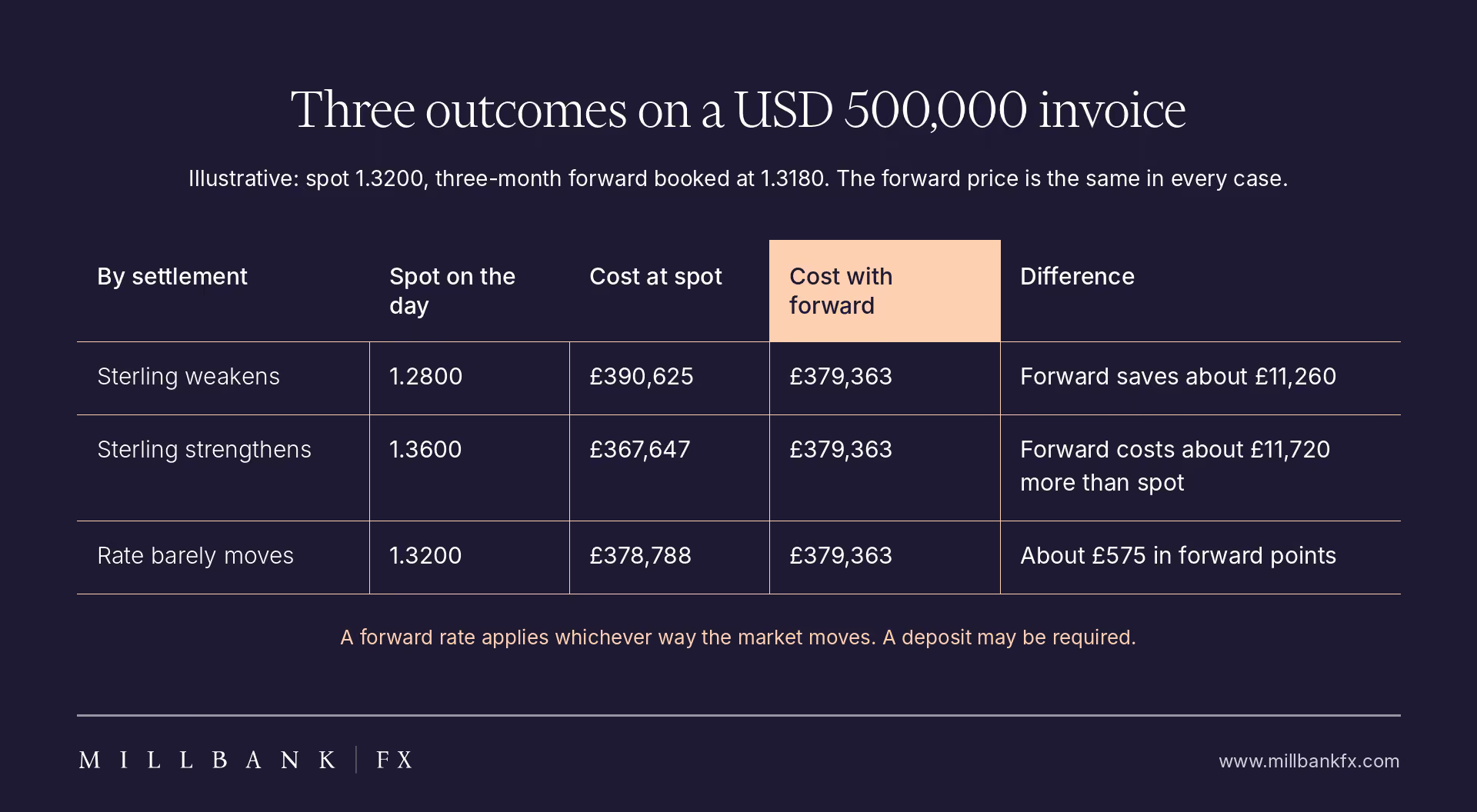
Notice what the importer got in all three cases: the price it was promised on the day it signed the purchase order. That is the product. A forward does not buy you a better rate. It buys you an answer, and it takes away the upside along with the downside. Finance teams who treat forwards as insurance on the plan tend to be happy with them. Finance teams who treat them as a way to beat the market are usually disappointed within a year.
The four types you will actually be offered
A fixed-date forward settles on one agreed day. Simple, and right for a single invoice with a known due date.
A window forward lets you settle at any point inside an agreed window, say the whole of March. Shipping dates slip and invoices arrive late; a window absorbs that without the cost of rolling a contract. Our guide to window forwards versus flexible forwards goes into the trade-offs.
A flexible, or open, forward lets you draw down the contract in pieces, as and when payments fall due, until the full amount is used by the final date. Good for a run of payments to the same supplier across a quarter.
A non-deliverable forward is for currencies that cannot be freely delivered offshore. Instead of handing over the restricted currency, the contract settles the difference between the agreed rate and the market rate in a convertible currency. Useful, specialised, and worth a conversation with a dealer before you touch one.
When a forward is the right tool
A forward suits a known future cash flow in a foreign currency. A signed purchase order on sixty-day terms. Overseas revenue repatriated on a fixed schedule. Monthly payroll for a team in Portugal. A tender you have priced in dollars for the season ahead. A machine with a deposit due now and the balance due on delivery in May.
What those have in common is that the amount and the date are real. Forwards work badly when either is a guess, and that brings us to the part of this article worth reading twice.
Where businesses get caught
A forward is an obligation, not an option. If the order is cancelled, the shipment slips six months or the customer never pays, you still have a contract to settle. Your provider can usually close it out or roll it, but the cost of doing so depends entirely on where the market has moved. The single most common way a business ends up holding currency it does not need is by hedging a forecast as if it were a confirmed flow. Our view, for what it is worth: hedge the confirmed part of your exposure, and be deliberately cautious with the rest. Covering somewhere between half and four-fifths of a forecast, then adding cover as orders firm up, is a sensible starting point for most businesses, and the right figure depends on how good your forecasting is and how much cash-flow variability you can live with. Our currency risk management page sets out how we work through that with clients.
It fixes the rate in both directions. If the market moves in your favour after you have hedged, your sterling cost does not fall. Nobody enjoys watching that happen. It is still the correct outcome of a contract that did what you asked it to do.
A deposit may be required, and margin calls are possible. Your provider carries an exposure to you until the contract settles. Many providers take an initial deposit and may ask for more if the market moves against the contract beyond an agreed threshold. The terms vary enormously between providers and depend on the client's financial position and how much credit is being requested. Get them in writing before you book. The 2025 collapse of a listed UK broker that had offered clients "zero-zero" margin terms was a reminder that this is not a theoretical risk.
What a forward costs
There is no upfront premium on a plain forward, which is the main thing separating it from a currency option. The cost sits in two places. The forward points, which can be for you or against you depending on the pair and direction. And the provider's margin, the gap between the interbank rate and the rate you are quoted. The margin is the part worth agreeing upfront as a fixed structure rather than trade by trade, because a margin that was never agreed cannot be audited later. Some providers also charge account or payment fees. Ask for every charge, in writing, before the first trade, so you can compare the all-in cost of a forward across providers on equal terms.
One more cost that is not money: accounting. How a forward is recognised, and whether hedge accounting applies, depends on your reporting framework and the purpose of the contract. That is a question for your auditor, and a better one to ask before you book a large or long-dated contract than at year end.
Booking a forward with Millbank FX
As an FCA-authorised payment institution we complete know-your-customer checks before any trade, which in practice means identification, incorporation documents and recent bank statements. We agree the pricing structure before you trade. Any deposit or margin requirement is assessed case by case and confirmed before the first contract is booked, not after a market move. Your dealer confirms the rate, amount and settlement date or window in writing. On the day, you send sterling and we deliver the currency to your account or straight to your supplier.
Forwards sit alongside spot conversions, market orders and stop losses and multi-currency accounts. Which mix is right depends on the shape of your flows, which is what a strategy session is for.
This article is general information, not advice. Exchange rates fluctuate. A forward contract fixes a rate that applies regardless of how the market moves afterwards, and a deposit or additional margin may be required depending on the terms agreed.