
Corporate FX, or business foreign exchange, is everything a company does to convert currency, move money across borders and stop exchange-rate movements from eating its margin. In practice that means spot conversions, forward contracts, market orders, multi-currency accounts and international payments, plus the thinking that decides when to use which. It is not holiday money and it is not forex trading. A trader takes on currency exposure hoping to profit from it. A business hedges to get rid of it.
Most UK businesses start doing their FX through their bank because the account is already there, and a good number never think about it again. That is fine while the amounts are small. It stops being fine at the point where a 3% move in GBP/USD is worth more than the quarter's profit, and plenty of businesses pass that point without noticing.
Who actually needs this
Importers paying suppliers in dollars, euros or renminbi on sixty or ninety day terms. Exporters invoicing customers in their local currency. Groups moving profit back from an overseas subsidiary, or funding one. Anyone paying staff or contractors abroad every month. Marketplace sellers receiving payouts in four currencies. And above all, low-margin traders in produce, commodities and electronics, where a currency move of two or three per cent is the whole net margin on a deal.
Size matters less than people think. What matters is the ratio of currency exposure to margin. A business turning over £8 million with £3 million of dollar purchases and a 6% net margin has far more riding on GBP/USD than a £50 million business with a few euro costs in the mix. The first one needs a plan. The second can probably live with its bank.
The six pieces of a corporate FX service
Spot. Buying or selling currency at today's rate for settlement within two business days. The default for anything due now. You pay a margin on the interbank rate, and whether that margin is agreed in advance or applied quietly is the single most important thing to find out about any provider.
Forwards. Fixing today's rate for a payment on a future date, so the sterling cost of a known invoice stops moving. The core tool for importers and exporters, and a binding one: the rate applies whichever way the market goes. Our guide to FX forward contracts has the worked numbers and the risks.
Market orders and stop losses. Standing instructions to buy or sell if the market reaches a level you choose. A market order targets a rate you would be glad to get; a stop loss caps the worst rate you are prepared to accept. Both run around the clock without anyone watching a screen. See market orders and stop losses.
Multi-currency accounts. An account in your company's name that holds several currencies, so dollars received from a customer can sit until they are needed to pay a dollar supplier, without converting twice. The word "named" matters: customers paying into an account that carries your business's name rather than the provider's are noticeably less nervous. Our named multi-currency account page explains how it works.
International payments. Getting the currency to a beneficiary abroad, by SWIFT or local clearing, with tracking. The questions that matter are cut-off times, which currencies can be delivered locally rather than through a chain of correspondent banks, and what happens when a payment is held. See international payments.
Market analysis and strategy. Not forecasts. Nobody forecasts currencies reliably, and a provider who says otherwise should be shown the door. What a good dealer provides is context on what is moving your currencies and a structured view on how much of your exposure to cover and when, grounded in your own flows rather than a feeling about the dollar. See FX market analysis.
How a specialist provider differs from your bank
It is worth being fair here. MillTech's 2025 survey of UK corporates found 53% of firms very satisfied with their main bank or FX provider, so this is not a story about banks being bad. The differences are structural, and whether they matter depends on the size and shape of your flows.
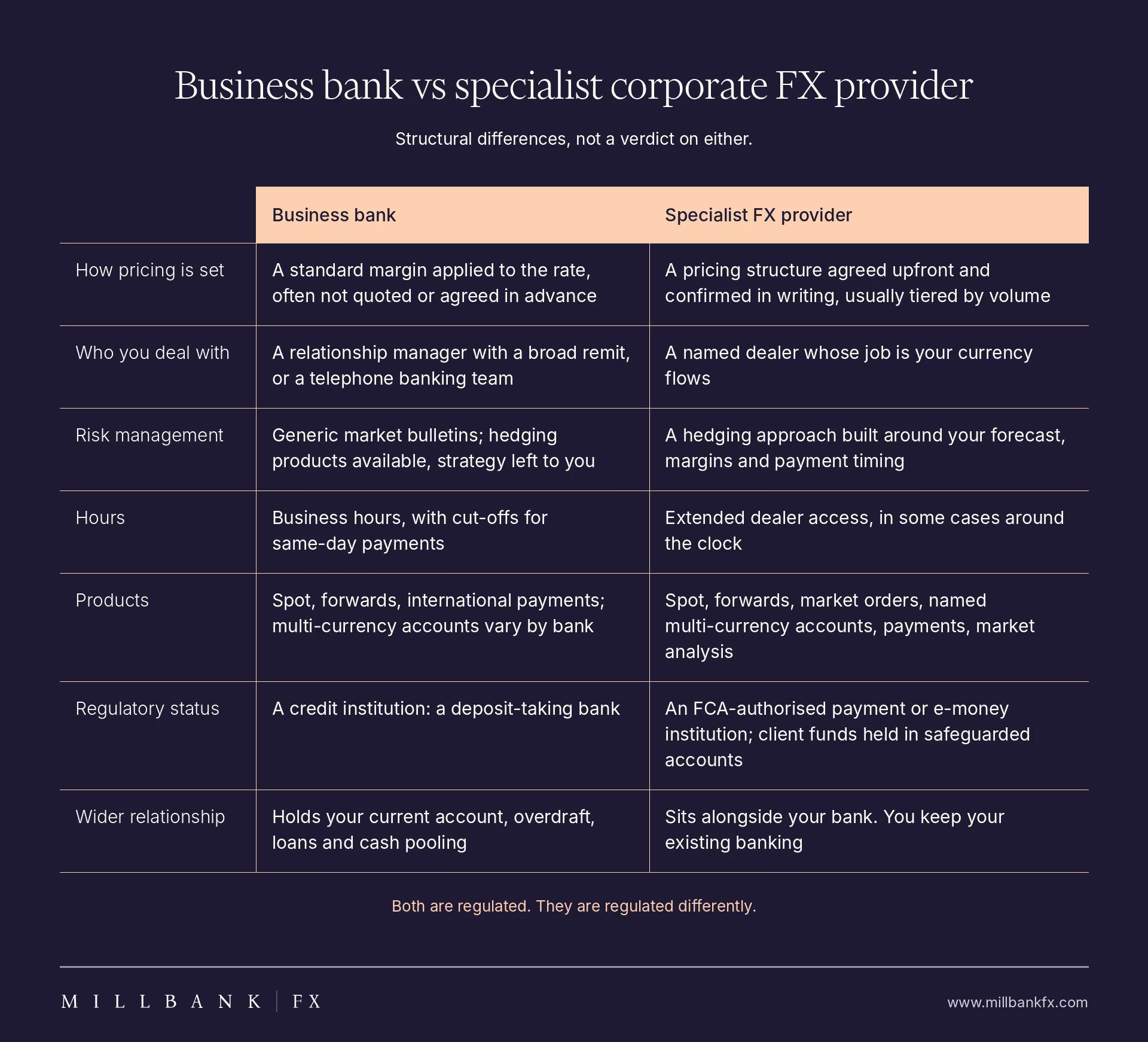
Pricing. A bank typically applies a standard margin to the rate, and that margin is often not quoted or agreed in advance. A specialist typically agrees a pricing structure with you upfront, in writing, usually tiered by volume. One of those you can audit. The other you cannot.
Who you speak to. At a bank, a relationship manager with a broad remit or a telephone team. At a specialist, a named dealer whose job is your currency flows and who will know your supplier list by the second month.
Risk management. Banks publish market bulletins and offer hedging products, and then it is largely up to you. A specialist builds a hedging approach around your forecast, margins and payment timing, and revisits it as the business changes.
Hours and products. Banks run business hours with cut-offs. Specialists offer extended dealer access, in some cases around the clock, and a wider product set including market orders and named multi-currency accounts.
Regulation. This is the one people get wrong in both directions. A bank is a credit institution, a deposit taker. A UK specialist is usually an FCA-authorised payment institution or e-money institution, required to hold client funds in safeguarded accounts separate from its own money. Since 7 May 2026 that regime also requires authorised payment institutions to file monthly safeguarding returns with the FCA and to have an annual safeguarding audit. Both are regulated. They are regulated differently, and anyone who tells you otherwise is selling something.
The wider relationship. Your bank holds the current account, the overdraft, the loans, the cash pooling. A specialist sits alongside all of that. You do not have to leave your bank, and nearly nobody does. The usual arrangement is that the bank keeps the operating account and the lending while the specialist handles conversion and international payments.
What it costs, and the question to ask instead of "what's your spread?"
The main cost of any FX service is the margin between the interbank rate and the rate you get. It varies with volume, currency pair, product and service level, and it is almost never the same for two clients. Some providers add account, payment or product fees. Forwards may need a deposit.
"What's your spread versus my bank?" sounds like a hard-nosed question. It isn't. No provider can answer it accurately without knowing your flows, and most people who ask it cannot say what their bank's margin is either, because it was never agreed. The question that gets you somewhere is this: will you set out in writing, before I trade, the margin on the rate and whether it is fixed for the relationship, any account or payment fees, the deposit and margin-call terms on forwards, and what the service includes? Ask it of every provider, including your bank. With those four answers you can compare on a like-for-like basis. Our article on running a foreign exchange audit shows how to work out what you are paying today.
Choosing one
Check the FCA register and make sure the permissions and reference number match what the firm tells you; ours is 787366. Ask how client funds are held and expect to hear "safeguarded account, separate from the firm's own funds, at a credit institution". Get the pricing in writing before the first trade. Find out who you will actually speak to. Check they can deliver the currencies you pay, and whether locally or via SWIFT. Ask whether they give you a tracking reference and will trace a held payment. And pay attention to onboarding: identification, incorporation documents and bank statements are standard for any FCA-authorised firm. A provider that asks for very little at the start is a provider that will ask for a great deal on the day a payment is stuck.
How Millbank FX works
We provide corporate FX to UK and international businesses: currency risk management, international payments to more than 120 countries, named multi-currency accounts, institutional FX rates, market orders and Bloomberg-based market analysis. Pricing is agreed upfront. Each client has a dedicated dealer. Client funds are held in safeguarded accounts. You keep your bank. The first step is a strategy session in which we look at your flows, exposure and current arrangements, or you can open an account directly if you would rather skip the conversation.
This article is general information, not advice. Exchange rates fluctuate, and the cost of any FX service depends on volumes, currencies and the products used. Forward contracts fix a rate that applies regardless of later market movements and may require a deposit.