Ask most finance directors what their business spent on currency conversion last year and you get a pause. Not because they are careless. The number is not on an invoice, it is not on a statement and it was never agreed with anyone. It was just in the rate. A foreign exchange audit is how you find it, and it takes about half an hour once the data is in front of you.
The audit answers three questions. What are we actually paying to convert currency? How exposed are we to rate moves over the next twelve months? And is anyone managing that, or is it just happening to us? Most businesses doing this for the first time are surprised by at least one of the three.
Why nobody knows the number
The margin on a conversion is built into the exchange rate rather than charged as a line item, so it never appears in the accounts as a cost. MillTech's 2025 survey of UK corporate finance leaders found 24% citing the complexity of calculating FX costs as a problem in its own right, and the same survey put the average cost of hedging up 66% on the year. In our own conversations with finance teams, almost everyone can say how much currency they bought. Almost nobody can say what rate margin they paid, for the simple reason that it was never written down.
Exposure is usually better understood, but not always. Sterling went from a four-year high against the dollar in June 2025 to its worst month in three years in July. A business that had not mapped its dollar purchases month by month found out what that swing cost when the invoices landed, which is the wrong time to find out anything.
The audit, in eight steps
1. Pull twelve months of conversions
From your bank or provider, export every currency conversion in the last year: date, currencies, amount, the rate you received and any fee charged separately. If your provider cannot produce this easily, write that down. It is a finding.
2. Find the mid-market rate for each trade
The mid-market rate is the midpoint between the interbank buy and sell prices at the time. Bloomberg or Refinitiv if you have them; the Bank of England's daily spot rates and the ECB's reference rates for euro pairs if you do not; any historical rate site for a rough check. Match to the trade date. For an annual review, the exact minute does not matter nearly as much as people fear.
3. Work out the margin on each one
Margin, as a percentage, is the mid-market rate minus the rate you received, divided by the mid-market rate. Multiply by the sterling value of the trade and you have it in pounds.
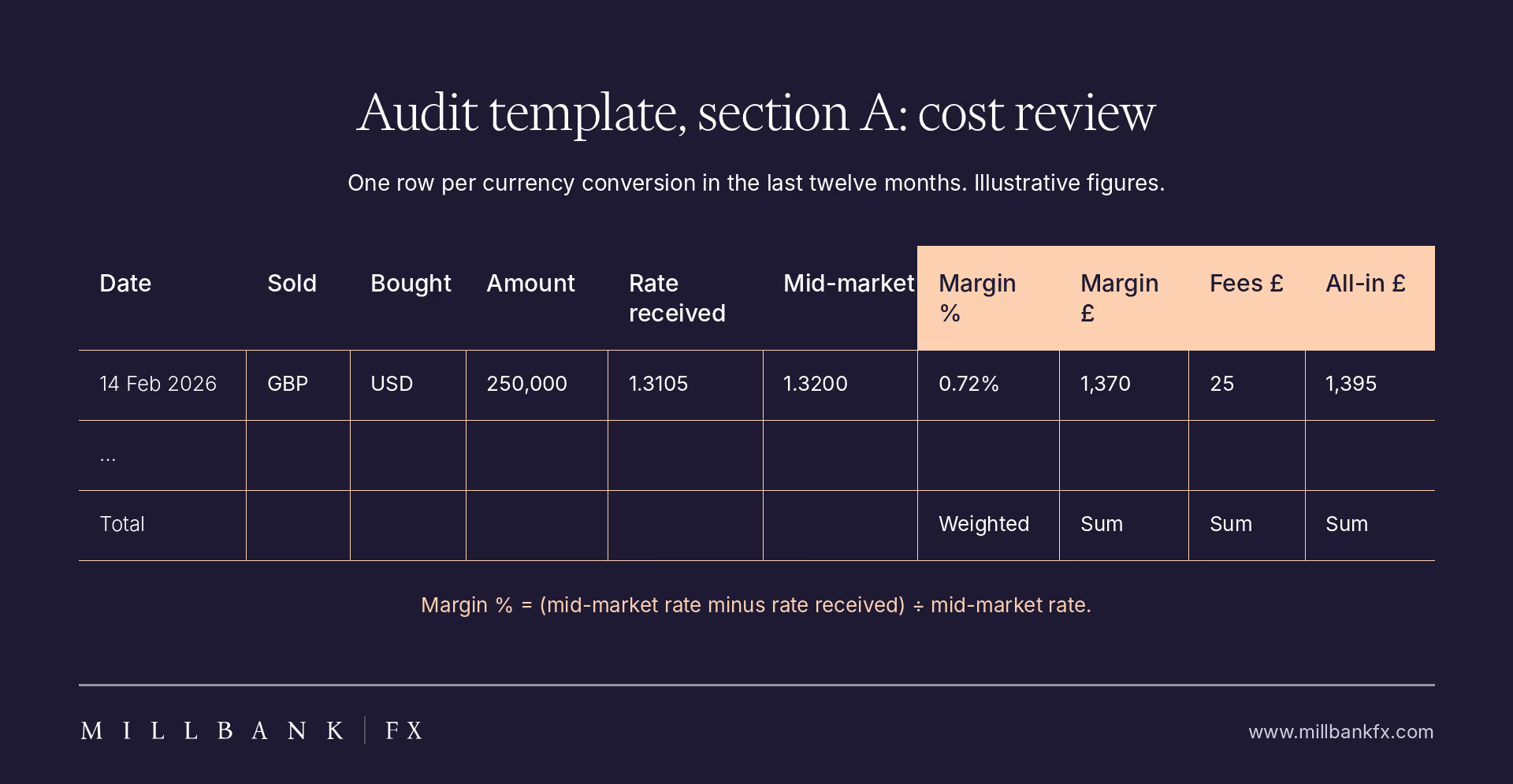
An illustration. A business bought USD 250,000 at 1.3105 on a day when mid-market was 1.3200. It paid £190,766. At mid-market it would have paid £189,394. That is a margin of 0.72%, about £1,370 on one trade. Twelve trades like it across USD 3 million would be roughly £16,500 in rate margin for the year. Whether that is reasonable depends on volume, currency pair and what service came with it. Which is the point of the next step.
4. Add every other charge
Payment fees. Account fees. Charges deducted by intermediary banks on the way, which you will only discover by asking your beneficiaries whether they received the full amount. Any deposit or margin-call interest on forwards. Add it all to the rate margin and you have the all-in annual cost of FX. That is the number that was never in the accounts.
5. Map the next twelve months of exposure
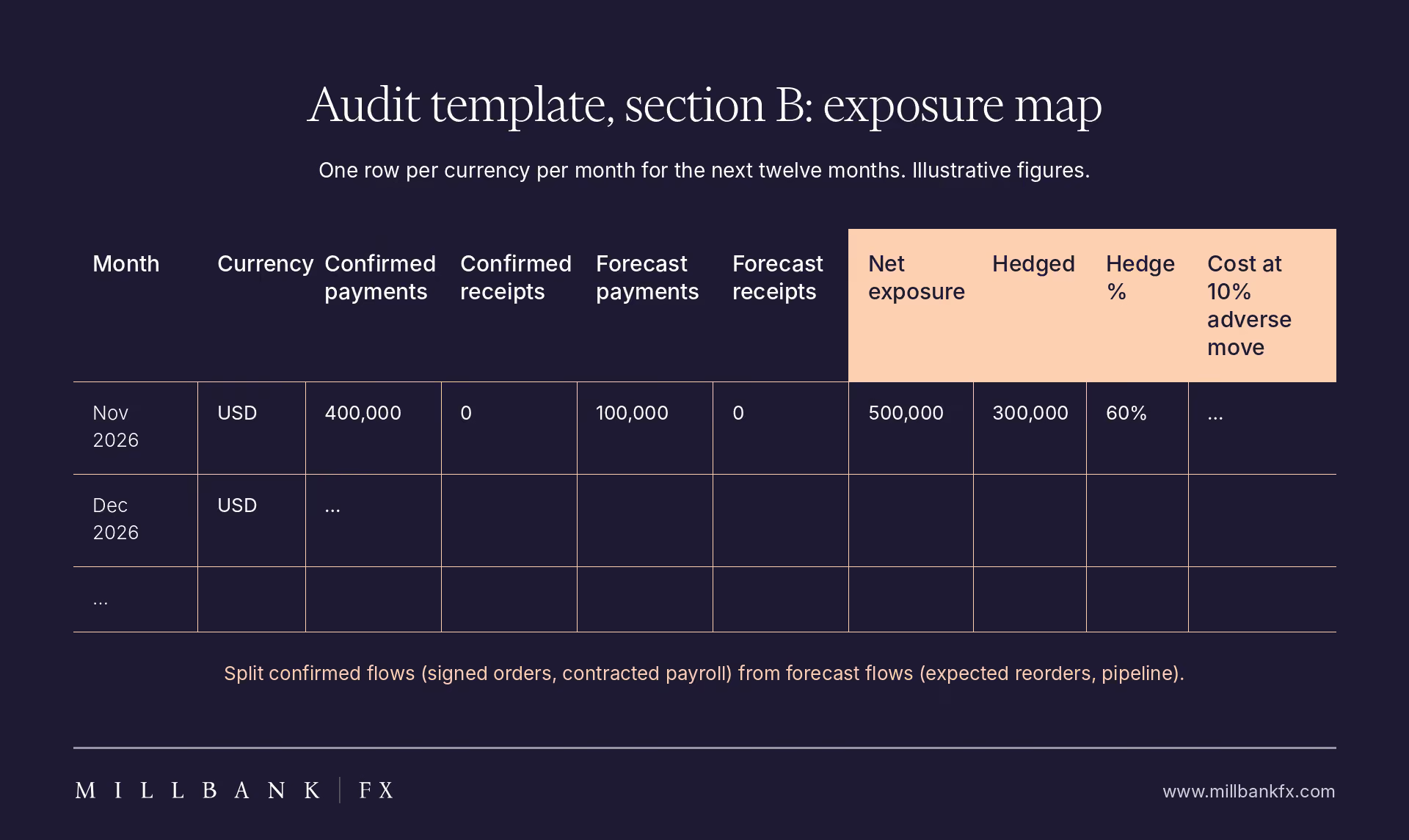
By currency and by month, list every foreign-currency payment and receipt you expect. Split confirmed flows (signed orders, contracted payroll) from forecast flows (expected reorders, pipeline). Net off any currency you both pay and receive. What remains is your transaction exposure: the amount in each currency whose sterling value is still unknown.
6. Run the sensitivity test
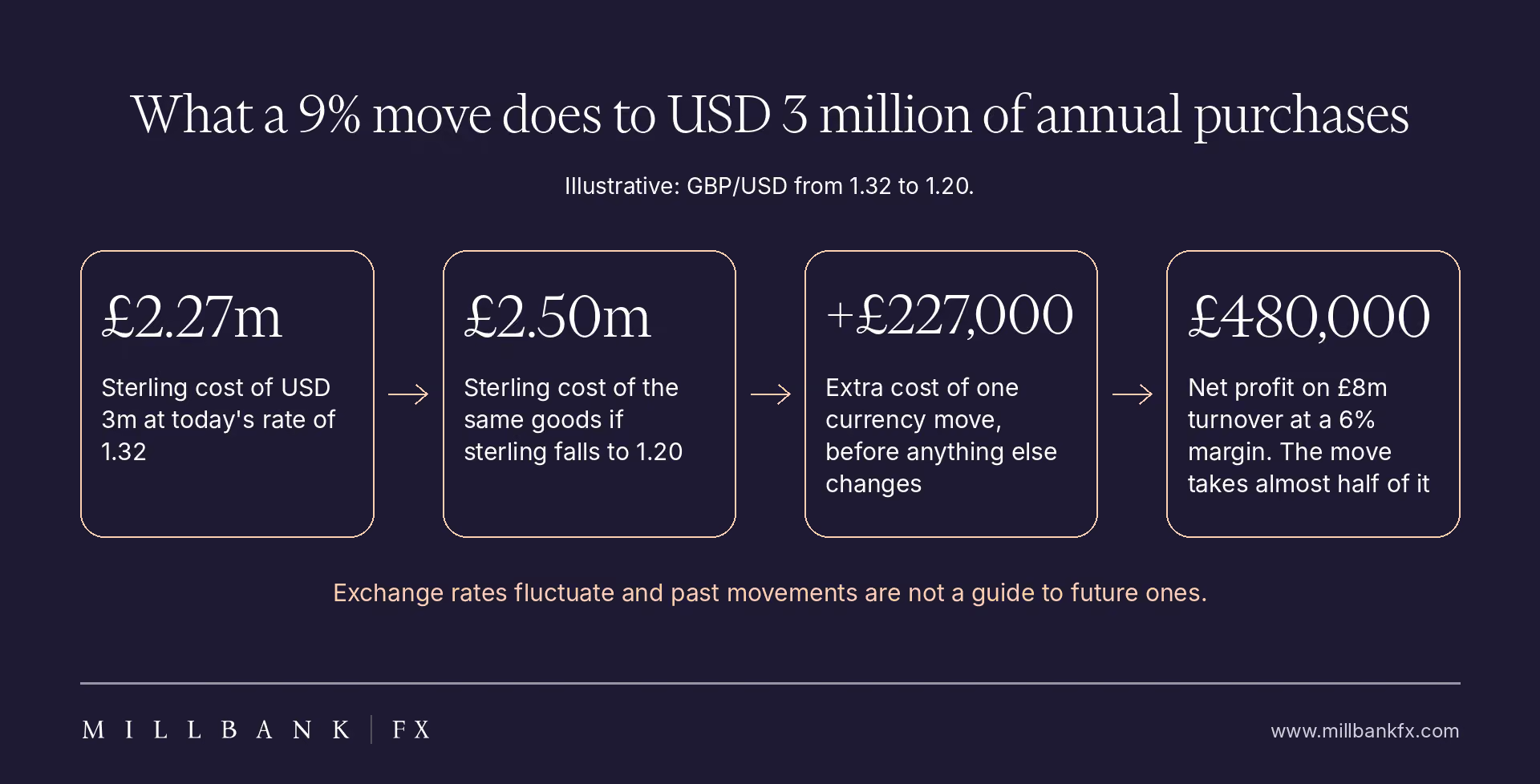
Take your largest exposure and ask what a 5% and a 10% adverse move does to it. A business buying USD 3 million a year with GBP/USD at 1.32 has a sterling cost of about £2.27 million. If sterling fell to 1.20, a move of roughly 9%, that cost rises to £2.5 million. Around £227,000, gone. For a business with £8 million of turnover and a 6% net margin, which is £480,000, one currency move has just eaten almost half the year's profit. The exercise is not about predicting the move. It is about seeing the size of it next to your margin, because that comparison is what decides whether you need a hedging policy or merely a good bank.
7. Look at how it is being managed
Six questions, answered yes or no with a note. Is there a written FX policy saying who can trade, up to what amount, with whose approval? What proportion of confirmed exposure is hedged, and was that a decision or an accident? If forwards are used, what are the deposit and margin-call terms, and has anyone read them? Was pricing agreed in writing with the current provider or applied trade by trade? How many payments have been held in the last year, and for how long? When something goes wrong, who at the provider do you ring, and do they pick up?
8. Score it
Red flags that justify doing something: you cannot identify the rate margin; no pricing structure was ever agreed; hedging is either none of a forecast or all of it; a single provider whose margin-call terms nobody has read; payments regularly held with no explanation. Green flags: agreed pricing, a written policy, confirmed flows hedged in layers, forecast flows partly covered, a named contact who answers the phone. Few businesses are all one colour. Most are green on two and red on three, and the three are usually fixable inside a quarter.
A template you can copy into a sheet
Section A is the cost review, one row per conversion, with these columns: date, currency sold, currency bought, amount bought, rate received, mid-market rate, margin as a percentage, margin in pounds, other fees in pounds, all-in cost in pounds. Total the last three and weight the margin percentage by volume.
Section B is the exposure map, one row per currency per month: month, currency, confirmed payments, confirmed receipts, forecast payments, forecast receipts, net exposure, amount hedged, hedge percentage, and the sterling cost of the net exposure at a 10% adverse move.
Section C is the six process questions from step 7.
What to do with it
Take the cost review to your current provider first. Ask them to confirm the margin you have calculated and to agree a pricing structure in writing going forward. A surprising number will, once they know you are looking. Then benchmark with a second provider: give them the same twelve months of trades and ask what they would have charged under an agreed structure, and compare all-in cost rather than headline rate. Our guide to corporate FX and how providers differ has the questions to ask. Finally, fix the exposure gaps. If confirmed flows are unhedged, or forecast flows are hedged in full, choose a hedge ratio on purpose. Our five steps to manage currency risk and guide to forward contracts cover the options.
Or let us run it
Millbank FX offers a free strategy session in which our Chief Commercial Officer goes through your payment flows, exposure and current arrangements using Bloomberg market data, and shows you where the business is exposed and what it is paying. No obligation, no requirement to open an account, and businesses already using a provider are welcome. It works best when you bring the twelve months of trade data from step one. Details are on our currency risk management page.
This article is general information, not advice, and all figures are illustrative. Exchange rates fluctuate and past movements are not a guide to future ones. Forward contracts fix a rate that applies regardless of later market moves and may require a deposit.